

To say decluttering can be difficult is something of an understatement. For a task that is often essential, it is tempting to put it off and avoid it indefinitely, until you find yourself weighed down with a load of ‘stuff’ you don’t need.
Worst of all, the longer you put it off, the harder it becomes when you eventually settle down to do it. The more stuff you have, the more overwhelming it can feel, and that overwhelm can make the task feel even more difficult.
When you’re pushed to this point, and decluttering becomes impossible, you need to take a ruthless approach – it’s the only way to make a real dent in a mountain of stuff.
But this is something else that’s easier to think about than action. In this post, we’ll share tips to help you overcome overwhelm when you’re decluttering so you can make a serious dent in the unnecessary ‘stuff’ you’ve accumulated.
First, we’ll start by looking at some ‘rules of decluttering’ that you can apply to your process to make it more effective.

Rules of Decluttering
What is the 50% rule with decluttering?
The 50% rule is, as you would expect, a rule about aiming to halve the clutter in a room. It’s a way to make your decluttering ‘big picture’ by setting a significant result that forces you to be ruthless.
A lot of people apply the 50% rule when they’re trying to make a big dent in their accumulated belongings. It’s simple to follow, which in itself can help some people tackle their overwhelm.
However, being so strict it can also be overwhelming in itself. It doesn’t give any concrete guidance on how to decide what to keep and, as a goal, is so significant it can be too much.
What is the 20/20 rule with decluttering?
The 20/20 rule says if something costs less than £20 to replace, and can be repurchased in under 20 mins, then you should get rid of it during decluttering.
This is a great rule to follow when you’re trying to be strict, as it sets specific parameters you can follow. It is not necessarily applicable to items that have sentimental appeal, but in terms of practical items, it can be something hard and fast to follow that reduces overwhelm because the decision is made for you.
Unlike the 50% rule, this approach isn’t about scale, so it shouldn’t create any extra stress. It’s simply a hard guideline you can set to reduce the mental load of decision-making.
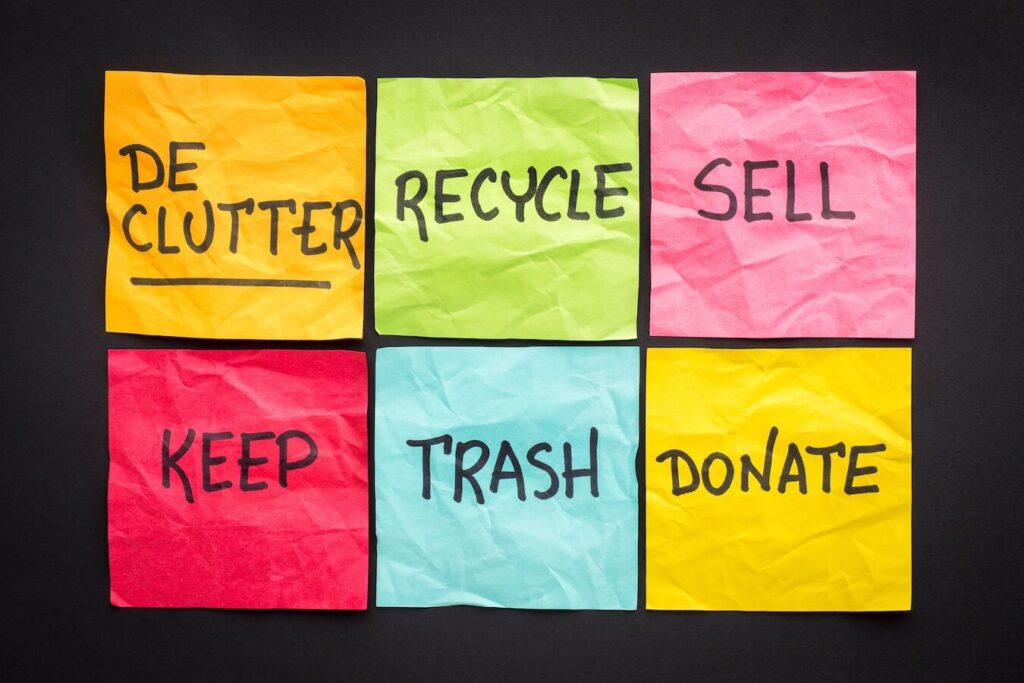
7 Tips to Help You Be More Ruthless When Decluttering
Think functional first
When you’re trying to be ruthless, it can be helpful to put practical considerations over sentimental ones.
This is particularly helpful in rooms like the bathroom or kitchen, where space is limited but there are certain functional items you rely on. Rather than leaving your bathroom counter cluttered with rarely used hygiene items or lavish skincare, cut down to the items you use every day or every week.
Does it spark joy?
By now, the concept of an item ‘sparking joy’ might feel so familiar it’s pointless to say. Yet tapping into your instincts and your emotional reactions is a good way to see through endless scenarios or questions your anxious mind might throw at you about whether to keep an item or not.
Can you imagine life without this item? Does it make your life easier, happier or improve it in some way on a regular basis? ‘Happier’ can mean something as simple as making you smile when you see it, or reminding you of a special memory – these are still important purposes. You’re looking to expel items with no purpose, and bringing you happiness is definitely a purpose.
If it does none of those things and doesn’t perform a practical function, it’s a safe bet you can get rid of it.
Stay focused on the short term
It’s impossible to know what will happen tomorrow, let alone five years from now. Yet, when it comes to decluttering, it’s easy to get caught up imagining scenarios that stretch far into the future that might change your attitude towards or need for an item.
Try not to get carried away with the future – instead, focus on what you need right now. Don’t fixate on items you needed long ago, but don’t try to second-guess what may happen in 12 months when your life may look different. If you don’t see yourself needing or enjoying something in the next 6-12 months, apply the 20-20 rule.
Don’t think about original costs
It can be difficult to dispose of something that once cost a lot of money. Clothes, gadgets and even ornaments that were expensive can feel like ‘investment pieces’, and you can quickly fall into considering whether you got your money’s worth before moving the item on.
This can trick you into believing the sunk cost fallacy – focusing on an item’s original cost rather than its current benefits.
Realistically, it doesn’t matter how much something costs on the day of purchase if it no longer delivers any value to you. Holding onto it will just further your wasted energy; it won’t let you earn back its worth if you’re not getting any value from it now. In fact, if it’s taking up space then it’s actively adding to its cost, not the value it delivers.

Don’t just do it once!
The more space you need to clear, the more items you need to choose whether to keep, the more pressure you’ll face. Leaving big gaps between decluttering will just leave you overwhelmed and swimming in stuff every time you try to tackle it. Constant overwhelm.
At least once a year, return to every room in your house. Not all on the same day, or even in the same season, but take time to check what you do and don’t need in every cupboard, drawer or nook. It will be a lot easier, quicker and more manageable on this scale when you only have a year’s worth of clutter to consider.
Don’t tackle too much at once
One of the most common barriers when it comes to decluttering is overwhelm. And decluttering is hard enough when you’re coming at it from a place of calm – when you start to get stressed because the scale of the job seems too big, it can become basically impossible.
One way to reduce your chance of overwhelm is to clear one small, fixed space at a time. That might be a single cupboard, corner of a room, or a relatively small room. Focus on methodically moving through this space, considering every item you need. Then stop.
Even if things are going well and you feel like you’re making great headway, it can be a better idea to just pause and leave things for the day. Otherwise, you risk getting halfway through your next space but being unable to finish it – and you may have made more mess in the process.
Place Items in Self-Storage To Test If You Need Them
If you really find yourself unable to dispose of items through binning, recycling or rehoming, then try packing them away and placing them in a local self-store facility instead.
By removing them from the house, you still clear space, but the pressure is reduced as you can always go fetch them if you need them. This can help you be more ruthless about sentimental items, or ones you’re certain you will end up needing eventually.
Set a fixed period based on your budget, three or six or even twelve months, then revisit your items in storage. If you haven’t needed the items across that period, you can trust it is unlikely you’ll need them in the near future either. This leaves you reassured about disposing of them in a suitable way, quietening the voice that says ‘you’ll need them the moment they’re gone’.
Find self storage units near you
If you live near Nottingham and are trying to clear your clutter but aren’t quite ready to commit to losing it completely, our personal storage units are the perfect compromise.
Clean, secure and available on flexible terms to suit your needs, they give you the option to get the clutter out of your house temporarily to take the pressure off the decluttering process.
Talk to us today to find out more.

